
“It’s such an uneven fight though,” Robin said helplessly. “You on one side, the whole of the Empire on the other.”
“Only if you think the Empire is inevitable,” said Griffin. “But it’s not.”
- R.F. Kuang, Babel
The future seems so bleak these days. Headlines tell us where we’re headed: war, environmental collapse, AI domination. Many of us are grieving. Not only the present state of the world, but also the future that seems to hang over us like a dystopian nightmare. It feels so inevitable. And that sense of inevitability makes that grief heavier.
But here’s the truth: there is no future.
Show me an example of something tangible from tomorrow that exists today. You can’t. The future doesn’t exist. It only shows up today in our anticipation of it. Anticipation is the only artifact of the future we’ll ever hold. Inevitability is an illusion.
That realization may sound hopeless, but to me it’s freeing and full of hope. If the future doesn't exist, then we are free to create it.
So why does something that doesn’t exist feel so unavoidable?
The problem is that the future often feels certain because of the stories we’re told about it. Through media, news, and entertainment, we’re bombarded with narratives that frame the future with so much certainty that we lean into them, even when they don’t serve us. And often, those stories reinforce old power structures.
Take the AI futures being sold to us right now. Whether it is AI taking over labor or running the world, the same power brokers remain in place. These futures are manufactured to benefit them. And when we prepare for them, when we accept them as inevitable, we surrender our power to shape new and better futures.
In his article Predictions Without Futures, Sun-ha Hong argues that these technologically driven futures, “technofutures”, give the illusion of progress while narrowing what’s possible. We’re sold images of flying cars and robot workers, while the reality is low-wage laborers suffering PTSD from content moderation and children forced into labor mining cobalt in the Democratic Republic of the Congo.
As Hong writes: “Technofutures preach revolutionary change while practicing a politics of inertia.” In other words, they promise revolution but deliver the sold old power structures dressed in chrome. The same colonial exploits were just given a shiny, metallic coat.
Not only do these colonized futures reproduce the same structures of harm and exploitation, but they also limit the possibilities of what the future could be. While we’re directed towards AI domination and neon cities, there are much more expansive futures available to us.
Take for example the USPS failed attempt at “rocket mail.” In 1959, the USPS launched a nuclear missile with a crate full of mail from Virginia to Florida, and hailed it as the future of mail delivery.
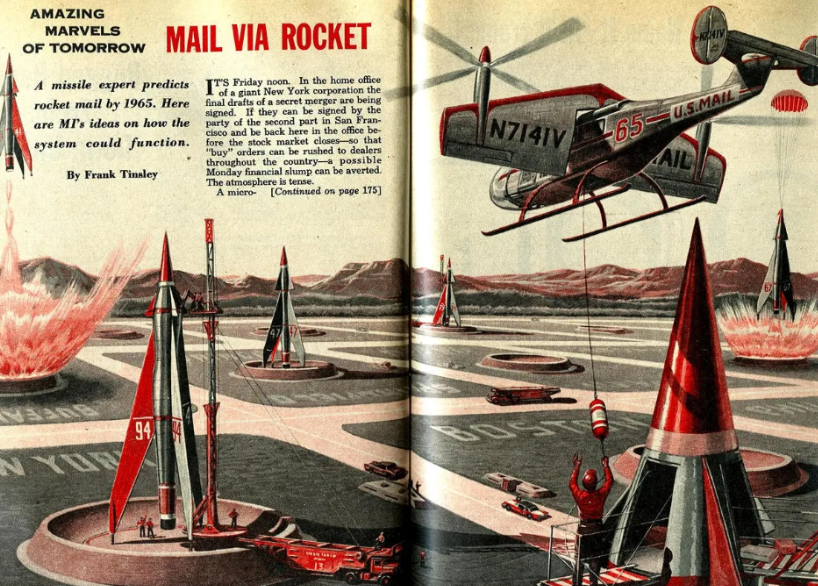
Imagine email never being invented because of a narrow focus on rocket mail. It seems ridiculous. Just as ridiculous as the futures being pushed on us now.
Instead we need a pluriversal approach. We need many people creating many different futures with all of our interests in mind. We need to push back against this colonization of the future.
To start, we can begin by asking: “What version of the future is shaping my choices without my permission?”
That question helps us reclaim our agency. It moves us out of inevitability and into possibility.
This is where Futures Literacy can be useful. UNESCO defines it as the ability to “imagine multiple futures, understand the role of anticipation, and use the future to innovate the present.”
Futures Literacy isn’t about prediction. It’s about paying attention to how our expectations of the future shape what we do right now. Practicing Futures Literacy helps us shift from inevitability to imagination. It invites us to ask:
What if the futures we’ve been sold are too small for us?
What if uncertainty isn’t a threat, but a resource?
What new options appear when we stop treating the future as fixed?
The stories we carry about the future shape how we live in the present. If we only cary dystopian scripts of collapse, domination, and scarcity, then we risk reproducing them. But if we practice imagining futures of care, abundance, and community, we begin to act as if those are possible too.
Novelty lives in uncertainty. By rejecting inevitability, we leave space for the unexpected to emerge. That’s where transformation begins. That’s where our grief can shift into creativity.
So when we say “there is no future,” we’re not closing the door. We’re opening it. We’re refusing inevitability, rejecting colonized futures, and making space for the futures we actually want to live into.
So when things are seeming bleak, just remember, there is no future. Then go create your own.
TJ Dean is the Associate Director of the Media Design Fellowship at the Wealth and Work Futures Lab.