
A Nod to the Blues: On Grief, Ocean, and Sky
Reflections from the close of this round of the Fellowship — and a season of honest reckoning.
As we come to the close of this round of the Fellowship, an image keeps returning to me. It lives somewhere between the depth of the ocean and the expanse of the sky — vast, uncontrollable, and breathtaking in equal measure. That image is grief.
For the better part of three years, we in the Wealth & Works Futures Lab have defined, studied, talked about, argued around, and confronted grief head on — from a multiplicity of sides. What I am beginning to accept is the utter, awesome nature of grief as a technology unto itself. It is a force that will neither bend nor be mastered by any form of intelligence — artificial or otherwise. It waxes and wanes, undulates, modulates, appears and reappears, regulates with or without our opinions about what it should or should not be.
Grief is the number one factor hidden in plain sight. It reminds me of the two places where most of us spend the least amount of time — the ocean and the sky. Ancient wisdom puts it plainly: as things are above, so they are below. The blues of the deep and the blues of the heights are one and the same.
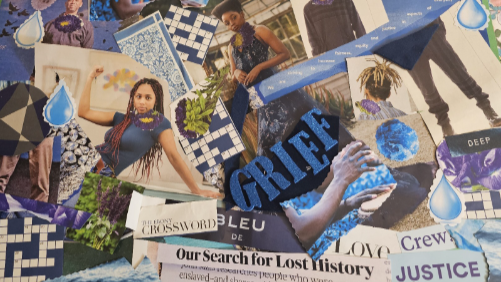
Collage created by the author, March 2026 — channeled through the energy of ancestors, community, and the work of the Fellowship.
The collage above is mine — made by my hands, but not by my hands alone. It rose out of the energy that moved through my work with the Fellows, staff, and community; through the ancestors who shaped the questions I carry; through the communities whose histories and futures this lab exists to serve. Look at what surfaced: GRIEF in glittering blue letters. JUSTICE. LOVE. “Our Search for Lost History.” Teardrops. Crossword puzzles. Figures in motion. Purple flowers. And underneath it all, a quilt — pieced together from fragments, just as we have been. The words “de bleu” and “DEEP” anchor the lower half, as if something older than me knew what needed to be said. I did not plan it. I received it.
Why Blue? Why Now?
Scholar and author Imani Perry has written about blue as a thread that connects disparate parts of the African diaspora² — and her reasoning speaks directly to this Fellowship’s work. Blue holds a duality: it carries the sorrow embedded in the blues tradition and the boundless hope of open sky and open sea. For Black communities in particular, that duality is not a contradiction. It is a survival strategy. Perry calls it a “blues-soaked sensibility” — a way of sustaining identity and humanity across centuries of struggle.
Artist Charly Palmer arrives at a similar place through a different door.³ His Blue Series began as a spiritual awakening — a “never-ending experiment” in which he releases control and lets the spirit lead. The footing and grounding for the work is history: Palmer was moved by the fact that enslaved Africans who worked in indigo production often had arms permanently stained blue from their labor. That blue mark, for him in part speaks as evidence to how grief becomes visible. In his piece “A Message from the Ancestors,” dripping blue paint becomes both wound and witness.
The convergence of their works with the collage drew me back to the expansiveness of how grief speaks and demands space to be made for it. Grief also asks for recognition — a collective noticing and devotion that calls out past our turning away and demands that we turn toward it. Palmer recently noted how Perry’s writings in Black in Blues² inspired his work, and in some ways I can feel their outstretched arms extending and inviting us to pick up this work — to use our craft, whatever it may be, to expand the circle of care.
What the Fellowship Has Taught Us About Grief
The work of this Fellowship has never been only about money, assets, or economic futures — though it is certainly about all of those things. It has been about what lives underneath those conversations. Grief is present in the histories that shaped who has wealth and who does not. It is present in the bodies that carry the weight of those histories forward. It is present in the boardrooms and the community meetings and the family kitchen tables where the hardest decisions get made.
To do transformative work in wealth and economic justice, we have come to believe that grief cannot be bypassed. It must be named, tended, and in some cases, honored. The blues tradition — in music, in visual art, in literature — has always known this. Black creative culture has developed an entire architecture for transforming sorrow into beauty, endurance, and even joy. That alchemy is not incidental to our work. It is instructive.
Entering May With Open Eyes
This May, as we close this chapter and prepare to open the next, we carry that spirit with us. We carry the blue of sky and ocean — not as symbols of melancholy, but as symbols of scale. Grief, like the sea, is larger than any one of us. Like the sky, it has no ceiling. And yet humans have always sailed oceans and studied skies and found meaning in them, mapped their depths, navigated by their light.
We are learning to do the same with grief — not to master it, but to move with it and build space for it. Not to resolve it, but to let it inform the quality of our attention, the depth of our care, and the ambition of our futures together.
A Fellow Apprentice of Grief
I write this as what Andrew Weller might call a fellow apprentice of grief. Not a master. Not an expert. An apprentice — still learning, still being shaped by the material itself. And in that apprenticeship, I find myself humbled and encouraged in equal measure.
Humbled, because grief itself is the teacher. Encouraged, because I am not learning alone. There is a vast and courageous community of people doing this work — researchers mapping its terrain, practitioners holding space for it in clinical and community settings, educators naming it in classrooms, artists tending to it in song and written word, families and neighbors honoring it in ritual and in the quiet dignity of simply showing up. Grief is being met, in so many rooms and on so many thresholds, with reverence.
That matters. Because grief deserves it. It requires it. It demands it. Not as burden, but as belonging — the kind of belonging that comes when something true is finally given its proper name and its proper place at the table.
The blues are not the end of the song. They are where the song gets honest.
A Closing Note: Listen
I want to leave you with music. Not words about music — music itself. John Coltrane’s “Blue Train” (1957)¹ is ten minutes and forty-four seconds of what language cannot fully hold. It moves the way grief moves — slowly at first, then with unexpected urgency, then into something that can only be called release. Coltrane does not resolve the tension so much as he teaches you to ride it.
This is a precursor. The next installment of this blog will go deeper into the relationship between music and grief — how sound has always done what ritual, language, and even time cannot do alone. For now, find ten minutes. Put on “Blue Train.” Let it take you somewhere. Notice where you land.
▶ John Coltrane — “Blue Train” (1957)
References & Citations
¹ Coltrane, John. “Blue Train.” Blue Train, Blue Note Records, 1957. Remastered 2003, Rudy Van Gelder Edition. Available at: https://www.youtube.com/watch?v=HT_Zs5FKDZE
² Perry, Imani. Black in Blues: How a Color Tells the Story of My People. Ecco/HarperCollins, 2025. Perry, a National Book Award–winning scholar and Harvard professor, traces the color blue across five centuries of Black history and culture — from West African indigo trade to the blues music tradition — as both a mark of sorrow and a strategy for survival.
³ Palmer, Charly. Blue Series. Ongoing. Palmer’s monochromatic blue paintings are rooted in honoring enslaved Africans whose arms were permanently stained from indigo labor. His work treats the color as both ancestral evidence and spiritual practice. See: charlypalmer.com
⁴ Weller, Andrew. Reference to the concept of the “fellow apprentice of grief” as a posture of humility and ongoing learning in relation to grief work.
Kevin Carter is the Senior Research + Practice Fellow at the Wealth and Work Futures Lab.